Accounting Entry

| An accounting entry is first entered into the accounting journal, also called the general journal. |
The general journal provides a chronological record of transactions that affect the financial statements. An accounting entry into the general journal is called a journal entry.
The Accounting Entry and Accounting Journal Illustrated
To illustrate the process, let’s review how Sunny started his business on January 1, 2010, and record those transactions in the accounting journal.
- Jan. 1 Sunny invested $50,000 into his new business, Sunny Sunglasses Shop.
- Jan. 1 Purchased inventory for $4,500. Paid $3,000 cash, with the balance of $1,500 due in 90 days.
- Jan. 1 Purchased land for $20,000 with $2,000 as a down payment, and a 15 year mortgage for $18,000.
- Jan. 1 Purchased insurance for the year for $2,400.
Sunny Sunglasses Shop
Accounting Entries in the
General Accounting Journal
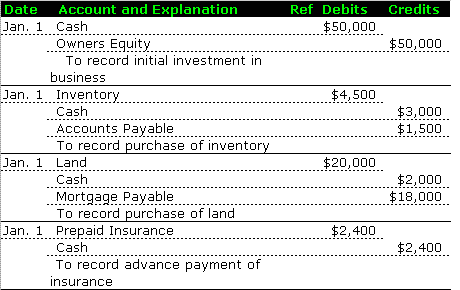
Accounting Entries in the General Accounting Journal
The Accounting Journal
The first column in the general accounting journal shows the date of the transaction. The second column shows the account debited or credited with a brief explanation. The third column shows a reference to the specific account.
When the accounting entries are posted into the individual general ledger accounts, a reference is made to the account number to indicate that the accounting entries were transferred. These general ledger accounts, called “T-Accounts,” are discussed in the next step in the accounting cycle, posting entries to general ledger.
Finally, the last two columns show the amount of the debit or the credit.
The Accounting Entry and Double Entry Bookkeeping
Each accounting entry made in the accounting journal maintains double entry bookkeeping by keeping the accounting equation in balance.
- The first transaction represents the owner’s investment in the business of $50,000. The investment increases the asset, cash, and owners equity by $50,000. Sunny debits cash because debits increase the asset accounts. He then credits owners equity because credits increase equity and liability accounts. This keeps the accounting equation in balance as follows:
Assets = Liabilities + Owners Equity $50,000 $0 $50,000 - The purchase of inventory represents an increase to an asset account for $4,500. Sunny debits cash because increases in assets are recorded as debits. Sunny used $3,000 in cash to purchase the inventory, so he credits cash since decreases to assets are recorded as credits. Accounts payable, a liability, represents inventory purchased on account. Because increases to liabilities are recorded as credits, Sunny credits the balance owed for $1,500. This accounting entry also keeps the accounting equation in balance:
Assets: Inventory and Cash = Liabilities + Owners Equity $4,500 ($3,000) $1,500 $0
Sunny exchanged $3,000 cash for $3,000 in inventory, and purchased $1,500 more inventory on account. This increased assets and liabilities by $1,500. The transaction did not affect owners equity. - The third transaction, the purchase of land, increased assets (land) by $20,000, so Sunny debits land for $20,000. Since he used $2,000 in cash as a down payment, he credits the asset account, cash, for the decrease. The mortgage represents a liability. Because increases to liabilities are recorded as credits, Sunny credits the balance owed of $18,000. This accounting entry also keeps the accounting equation in balance:
Assets: Land and Cash = Liabilities + Owners Equity $20,0000 ($2,000) $18,000 $0
Sunny exchanged $2,000 cash for a down payment for the land, and mortgaged the balance for $18,000. This increased assets and liabilities by $18,000. The transaction did not affect owners equity. - Finally, Sunny purchased insurance for the year. Prepaid insurance is an asset because it represents an insurance policy for one year, which is a future benefit to the company not yet consumed. He debits the asset account, prepaid insurance, and credits cash. This affected only one side of the accounting equation since he exchanged one asset, cash, for another asset, prepaid insurance.
Special Accounting Journals
Sometimes companies use special accounting journals to record accounting entries. This occurs when a company has many transactions of a similar nature. For example, in a purchases journal you can record all debit entries to purchases, and all credit entries to accounts payable. Similarly, in a sales journal you can record all debit entries to accounts receivable, and all credit entries to sales. You can also use separate cash journals to record cash receipts and cash payments.
The most common special accounting journals are listed below.
Special Accounting Journals
| Special Journal | Type of Transaction |
| Cash Receipts | All Cash Receipts |
| Cash Disbursements | All Cash Disbursements |
| Sales | All Sales on Credit |
| Inventory Purchases | Inventory Purchases on Credit |
Accounting entries not included in special accounting journals are recorded in the general accounting journal. No matter which accounting journals accountants use to record accounting entries, that information is then transferred to the general ledger accounts, which is the next step in the accounting cycle.
Step Three in the Accounting Cycle: Posting from the Accounting Journal to the Accounting Ledger
From Accounting Entry Back to the Online Accounting Main Page
Back to the Accounting Cycle Main Page
Back to the Accounting Terms Main Page
Business Accounting Home Page

Hi Donna,
An increase in inventory means the company purchased more goods, which is either a cash outlay (credit to cash) or accounts payable increase (credit to AP).
Since A=L+OE, assets, or increased inventory, is either offset by decrease in cash (asset), or an increase in the liability (AP).
Inventory increases also reduce the COGS for the period reported on the income statement to match costs of inventory with sales.
Thank you for visiting!
Kenneth Meunier
When there is Increase in Inventory, what accounts are affected?
Hi Thootte,
On the business side, the entry creates a cash asset and equity:
Also see Owner’s Equity
Thank you for visiting!
Kenneth Meunier
What will be the double entry of “Paid $2000 cash into business bank account”?
Thank you, Richard!
Kenneth Meunier
Like your page
Hello Don,
If you did not sell the stock, then the gain would be an unrealized gain recorded as:
When the stock is sold for a gain (or loss), the gain (or loss) becomes realized.
Losses are debits and gains are credits which adjust the value of the security.
Kenneth Meunier
My company invested funds in stock of a company called Make Money.
We purchased 1,000 shares at $10 per share. The price of the stock has gone up to $11.
How do I make a GJ entry so this is reflected on the balance sheet?
dandydon
Start the entry # over on the second page. For example, GJ-2-1 is page 2 entry # 1 which will reference the page and entry and make it easier to find.
I give each entry a code (GJ-1-1) for General Journal-page 1-entry #1; should I start the entry numbers over at: 1) the end of the page, 2) the end of the month, 3) the end of the quarter, 4) the end of the year, or 5) never.
Hi Brandi –
It is very similar to the land entry above. Just replace land with computer equipment for $12,000, keep your credit to cash but for $3,000, and replace mortgage payable with loans payable, computer for $9,000.
Kenneth
ok im confused how would i do this: bought computer equiptment for 12,000 and issued a check for 3,000 as a down payment
Hello Shveta,
Thank you for visiting Business Accounting Guides.
You can find all of that information in the chapter called The Accounting Cycle in my new book, Accounting Simplified: The Fast and Complete Guide to Accounting.
It is loaded with easy to understand accounting tips!
You can also find samples on this website.
Best Wishes,
Kenneth
SIR
PLEASE GIVE INFORMATION ABOUT THE JOURNAL ENTRY AND A TOPIC OF CHAPTER IN DOUBLE ENTRY BOOK KEEPING CHAPTER IN ACCOUNT (VOUCHER PREPARATION AND ACCOUNTING PROCEDURE-JOURNAL AND LEDGER )A TOPIC VICE INFORMATION WITH EXPLANATION NECESSARY FOR ME PLEASE SEND ME ON MY EMAIL ID.WITH A HUMBLE REQUEST
THANKS
WITH
BEST REGARDS
SHVETA
Awesome accounting examples I found here. Thanks a lot the authority indeed.
Borrower paid $500 to tax amount pass journal entry
Hi Nanette –
You can estimate uncollectible accounts based on how long the accounts have been outstanding called aging of accounts receivable.
Kenneth
What is my entry for long outstanding accounts receivable? We have no provision for bad debts. Should I just reverse the original entry? Dr Sales and Credit Accts Receivable?
paid bank charges to bank wht entry will pass
“A”borrowed Rs.10000 from “B”,after certain period ‘B” said to “A” to returned his money as a draft . but when “A” prepared a draft the bank charges of Rs.100 has been charged but “B” said to “A” the chrges hs been adjusted out of the Rs.1000 then how much amount of entry to pass by both “a” and “b” in his books.
cheque received and it got deposited in Bank Need what will be the entry if it got realised or if it got returned
Sold $23,000 of merchandise on acct, terms 1/20, n/30, FOB shipping point. The cost of merchandise sole was $12,000 and we paid $400.00 for shipping which was billed and added to the customer’s invoice.