Closing Entries

| Closing entries made in the accounting cycle bring the income statement accounts to zero so that the new reporting period will start with zero balances. |
Since we are reporting sales and expenses for January, for example, February sales and expenses should start with a zero balance to properly report sales, expenses, and net income only for the month of February. Accountants can close accounts for any reporting period (e.g. monthly, quarterly, and yearly).
Nominal Accounts and Real Accounts
|
The adjusted trial balance lists income statement accounts, or temporary accounts, highlighted below.
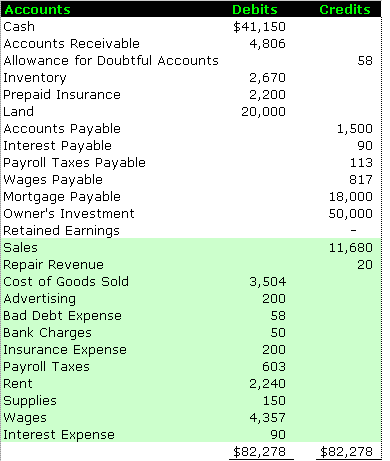
Adjusted Trial Balance
At the end of the reporting period, the credit accounts (i.e. sales accounts) are closed by making a debit entry for the balance, and the debit accounts (i.e. expense accounts) are closed by making a credit entry for the balance in the general ledger.
During this closing process, a new temporary account, called income summary, is created to transfer the income and expense account balances. The balance in the income summary account equals the difference between sales and expenses, which is then transferred to owner’s equity.
For example, Sunny Sunglasses Shop closed January sales and expense accounts in the general journal as follows:
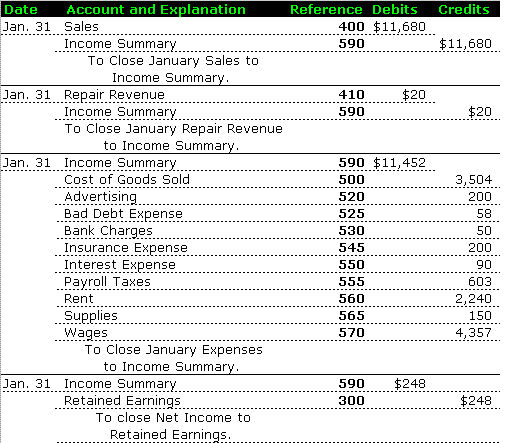
Accounting Journal: Closing Entries
Since sales and revenue accounts have a credit balance, these accounts are closed by debiting the sales and revenue accounts, and crediting the income summary account. Similarly, closing entries are made to the expense accounts by crediting each expense account, and debiting the income summary account.
The difference between sales and expenses, or net income, was transferred to the income summary account.
Calculating Net Income
| Sales | + Repair Revenue | – Expenses | = Net Income |
| $11,680 | + $20 | – $11,452 | = $248 |
The $248 equals net income and the balance in the income summary account after the sales and expense accounts are closed. In the final step, Sunny transferred the balance in the income summary account to retained earnings. Net income directly increases retained earnings and owner’s equity, or the value of the business as discussed in accounting formulas and net income.
The $248 transferred to retained earnings appears on the balance sheet template for January.
After the above entries are posted to the general ledger accounts, the general ledger sales and expense accounts show a zero balance. For example, the sales account and the wage expense account appear as follows in the general ledger after the closing entries are posted from the accounting journal to the accounting ledger.
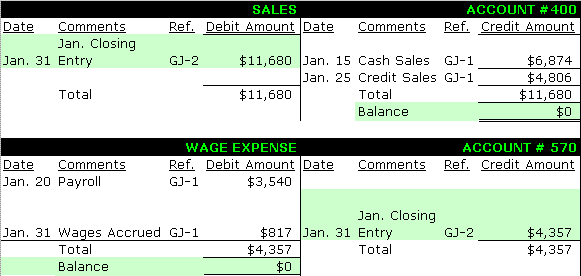
General Ledger Accounts with Closing Entries
Because the sales account has a credit balance, the closing entry is made on the debit side to bring the account balance to zero. Similarly, because expense accounts have debit balances, the closing entry is made on the credit side to bring the expense account balances to zero.
GJ-2 simply means these entries were made on the second page of the general journal and posted to the general ledger above. Similarly, the accounts listed on the general journal under the “Reference” column indicate the accounting entries were posted to the respective general ledger accounts to close the accounts for January.
Closing Entries Summary
Recording Closing Entries is a Three Step Process:
|
After the income statement accounts are closed, the company prepares a final trial balance.
From Closing Entries to Step 9 in the Accounting Cycle: Preparing the Final Trial Balance
Back to the Online Accounting Main Page
Back to the Accounting Cycle Main Page
Back to the Accounting Terms Main Page
Online Accounting and Business Accounting Home Page

Hi Tabby and thank you for your question.
Take the prior year GL and file it away for your recordkeeping after you carry the balances forward. Start a new journal for the new year as well. You will want to do that for recordkeeping, audits, etc.
For the balance sheet accounts you can carry the balance forward and start the GL for a new year. For the income statement accounts you can start the new GL with zero balances. This will help keep your financial statements in order and keep the years separate.
Kenneth
This is a probably a very simple answer for my question. Once the closing process has been completed and the post trial balance has been done, for the next accounting period, would I continue showing my general journal entries right where I left off and since the temporary accounts have a zero balance in the general ledger, would I just post my next transaction for the next accounting period right under the zero balance? Or would I need to start a new general journal and a new ledger for my temporary accounts? The problem that I need to do is all by hand, not computerized.
Hi Fido –
If you have a net loss the income summary will have a debit balance, so you can debit retained earnings and credit income summary to close it out. This will reduce retained earnings as a result of the net loss for the period.
Kenneth
What if we have a Net Loss instead of net income ?
can you show me about the closing entry for construction company ?
Hi Ashley –
If you need to add more interest, you can do that in an adjusting entry
Debit interest expense and credit interest payable (or credit cash if you are also actually paying the interest too).
if u have interest on a loan in the trial balance,and u have been given a percentage on the loan to calculate the loan in the trial balance, how will u treat it when ur calculation figure is bigger than the interest on loan figure in the trial balance.
Hi Sarah –
Your software should have a record of the financial statements. The accounts are only zeroed out to start a new accounting period, but the data should still be there from the latest and prior years. You can run the income statement, or you can simply run revenues and expenses for the entire year (and be sure to include any adjusting transactions).
Kenneth
After all closing journal entries were done on dec 31st, the P&L is now all zeroes as of Dec 31. So in order to see the details of how the company did in each P&L category (admins cost, COGS, sales, etc) do I now have to run reports from Jan 1 thru Dec 30? I’m confused. Thank you very much!
Hi Jharig –
The closing entries were made after the adjusting entries, so yes the temporary accounts were rolled into retained earnings, leaving the temporary accounts all with zero balances for January in this example.
But reversing entries are optional and are only made in certain situations (i.e. if an adjusting entry increased an asset or liability account). For example, the reversing entry in February of next period makes the expense account negative, but the entry to record it is positive in Feb, making it zero. This is because the actual expense was incurred in January, so the reversing entry eliminated it in Feb.
The steps in the accounting cycle cover the entire process from the original accounting journal entries to the optional reversing entries in the next period and should help clarify.
Kenneth
What about December Accrual Entries. The Closing entries will, in effect, reverse the entries in the temporary accounts, but not the permanent accounts. Therefore if they are reversed in the next period you will end up with correct permanent accounts, but incorrect temporary accounts.
Now how about showing me the closing entries for a trading entity that used Direct Extension method for their merchandise inventory (in the worksheet) then the same entity but using Adjusting Method this time. I really need to see the difference in the closing entries. “D thank you very much, I will wait for your update 😀
simply great explaination. Thank you very much.