Reversing Accounting Entry

| A reversing entry is an optional accounting entry that is made at the beginning of the next accounting period to simplify the accounting process. |
Reversing entries reverse an adjusting entry made at the end of the previous accounting period if the adjusting entry increased an asset or a liability account.
For example, the following review of last period’s adjusting entries will allow us to see if reversing entries would simplify transactions for the new accounting period.
Accounting Journal: Adjusting Entries
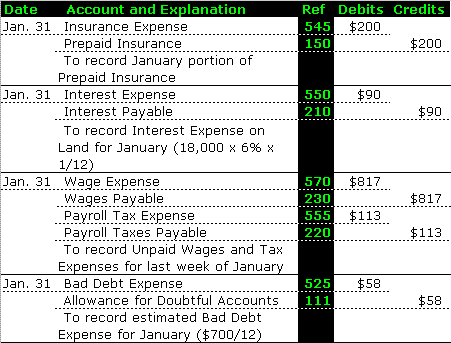
Accounting Journal with Adjusting Entries
The first adjusting accounting entry increased the insurance expense for January and decreased the prepaid insurance account by $200. Since the insurance was not originally recorded in an expense account, no reversing entry is necessary.
If Sunny originally recorded the prepaid insurance in an expense account, the transaction would appear as follows:
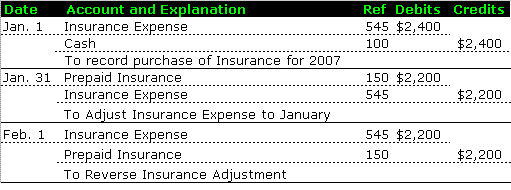
Accounting Journal: Adjusting and Reversing Accounting Entry
The first accounting entry recorded the initial insurance purchase in the expense account. Because the company issued financial statements for January, an adjusting accounting entry was required to report the January portion of the insurance expense. The adjusting entry created a balance in the prepaid insurance account of $2,200, and decreased the insurance expense account to equal $200.
The expense account was then closed, correctly reducing net income and retained earnings by $200 for January.
Since the company in this example initially recorded the insurance as an expense, the reversing accounting entry reduces the balance in prepaid insurance to zero and brings the expense balance in February to $2,200. If the company originally records insurance in the expense account, a reversing entry maintains the consistency of the original entry.
When monthly statements are issued, this amount must be adjusted each month to report $200 and show the balance in prepaid insurance as of the current month. If the company waits to report the income at year-end, no further adjustments would be needed for the year since the insurance expense correctly reported insurance expense for the year of $2,400, and the prepaid insurance account equals zero.
Since Sunny did not report the insurance in an expense account originally, but in prepaid insurance, an asset, only adjusting entries are required each month to report the correct amount of insurance expense ($200) and the current balance of prepaid insurance for the reporting period.
The interest expense was reported in January and represents an expense accrual. Oftentimes, a company will reverse expense accruals to simplify the reporting process for the next period. For example, Sunny may make the following reversing accounting entry at the beginning of February before making an interest payment:
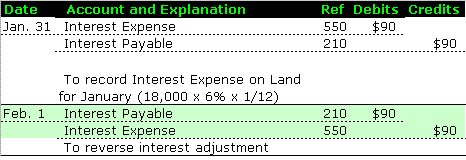
Accounting Journal: Adjusting and Reversing Accounting Entry for Interest
Keeping in mind that the business closed the expense account in January, the reversing entry creates a balance of ($90) for interest expense as of February 1. When the company pays the interest it will debit interest expense and credit cash. The expense account will correctly equal zero (credited for $90 in reversing entries, and debited for $90 when paid) since this amount was already recognized as an expense in January.
Alternatively, the company can debit interest payable and credit cash as payments are made, and not make any reversing entries.
Similarly, if the company pays the wages that were accrued in January for $817, a reverse entry may be made that debits wages payable and credits wage expense as follows:
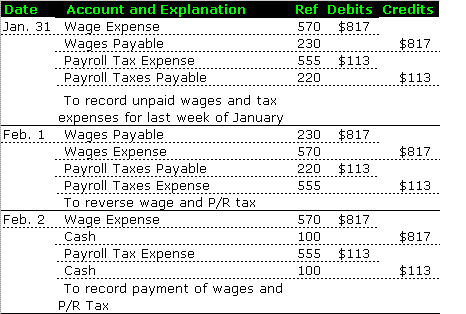
At the end of January the company entered an adjustment to accrue the wage and payroll tax expenses. The expense accounts were then closed, reducing net income and retained earnings by the amounts accrued at the end of January.
The reversing entry eliminates the wage and payroll tax payable account balances, and creates a negative balance in the expense accounts. When Sunny pays the wages on Feb. 2, the expense accounts correctly total zero since this amount was already recognized as an expense in January.
Sunny could just as easily debit the payable accounts and credit cash, and not enter any reversing entries at the beginning of the period.
The final adjusting entry for bad debt expense reduced the accounts receivable account, an asset account, through its contra account, and no reversing accounting entry is necessary.
Reversing Accounting Entry Summary
Reversing entries are not required but may help maintain consistency in the accounting cycle, and simplify bookkeeping. An easy rule to remember is that these accounting entries may be made at the beginning of a new period if:
|
From Reversing Accounting Entry back to the Online Accounting Main Page
Back to the Accounting Cycle Main Page

1.plant and equipment is depreciated at 20%p.a straight line. Depreciation is calculated as follow-(Cost x 20% x 31/ 365) = what is the amount and the journal entry for this
2.Sales comission accrued but not paid $5000 = what is the amount and journal entry
3.As at 30 june ($10000) reprsented the premium paid on annual policy starting on 1st may 2017. ( Insurance is written off at $1,000per month)= what will be the calculation amount and the journal entry for this
4.the company’s long term loan is at 8.00% p.a Interest is paid quarterly, but accrued monthly.( Interest= Loan Balance x interest rate x days in month / days in year).= what will be the clculation and the journal entry
5. Acrued electricity for july is $1800= what is the journal entry
6. Other Receivables are charged interest at the rate of 105 per annum, interest for july will need to be accured.( Interest= Other Rec x days in month / days in year) = what will be the calculation and the journal entry
good